
Obagi's New Multi-Acid Peel Pads Have Arrived in the UK — and They're a Lesson in How to Layer Acids Properly

Walk through the skincare routine of almost anyone who takes it seriously and you will find acids. A glycolic toner from one brand. A salicylic serum from another. Perhaps a lactic acid "resurfacing" product for the weekend. Acid layering — using more than one exfoliating acid for their combined effect — has gone from a professional technique to something people assemble themselves from separates, and search data suggests "can I mix acids" is one of the most-asked skincare questions of the past two years.
The thinking behind it is sound. The execution usually is not. And this week there is a reason to talk about it, because Obagi Medical — the pharmaceutical-grade skincare brand we stock and prescribe at the clinic — has just launched its CLENZIderm M.D. Resurfacing Multi-Acid Peel Pads in the UK, and they are, in effect, acid layering done by a formulation chemist instead of by guesswork on a bathroom shelf.

Why layer acids at all?
Because different acids do different jobs, in different places.
Glycolic acid, the smallest of the alpha-hydroxy acids, works at the surface: it loosens the bonds holding dead cells together, which smooths texture and brightens dull skin, and there is decent evidence it supports collagen in the longer term. Salicylic acid is different in kind, not just in strength — it is oil-soluble, so rather than working across the surface it travels down into the pore, where it dissolves the congestion that becomes blackheads and breakouts. Mandelic acid is the gentle giant of the AHA family: its molecule is large, so it penetrates slowly and evenly, which makes it far kinder to reactive skin and a favourite for deeper skin tones, where harsher exfoliation can leave dark marks behind. And phytic acid is the quiet one — a mild exfoliant that is also an antioxidant, often used to brighten without adding irritation.
No single acid does all four jobs. That is the honest logic behind layering, and it is why professional peels have combined acids for decades.
Where the DIY version goes wrong
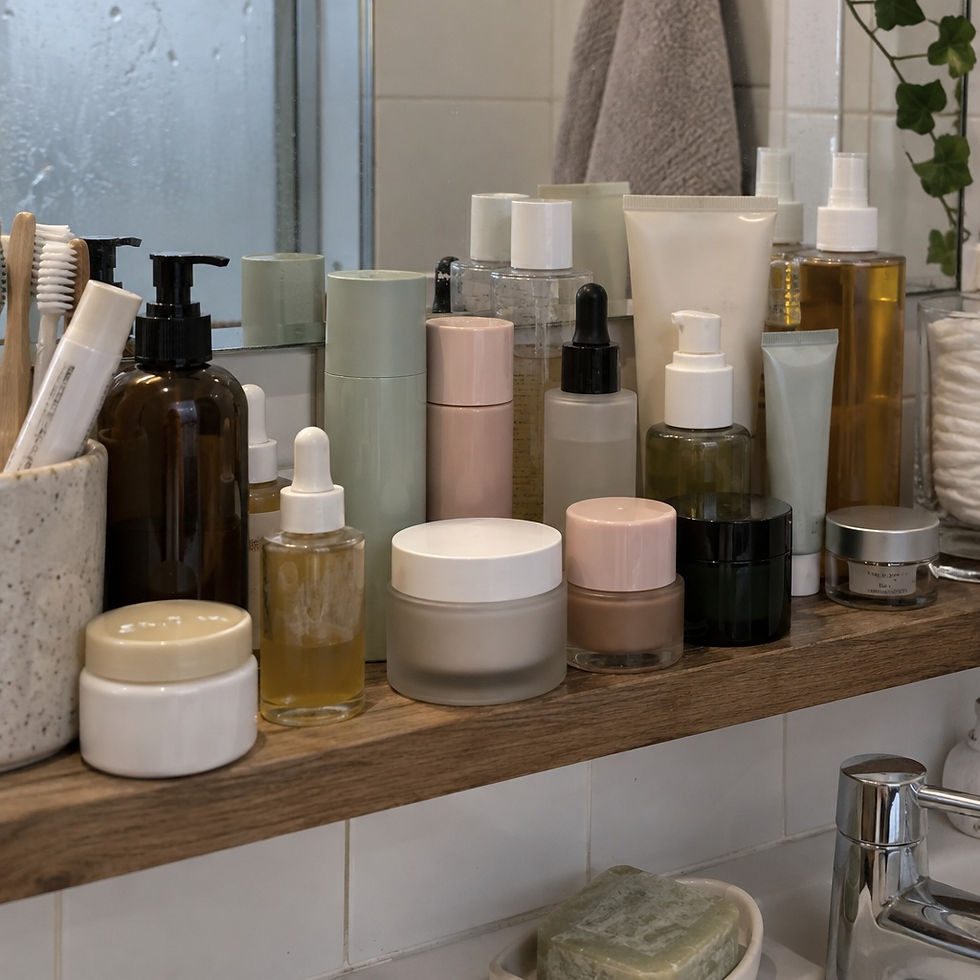
The problem is that stacking separate acid products multiplies three things at once: the total acid load, the time your skin spends at a low pH, and the chance that two formulas interact in ways neither brand tested. The result walks through our door regularly — a stinging, shiny, red face attached to someone doing what an online routine told them to. Dermatologists have a name for the pattern: a damaged skin barrier from over-exfoliation. Once the barrier is compromised, everything stings, nothing works, and the only fix is to stop all of it for weeks.
There is a second, less discussed risk. In medium and deeper skin tones, irritation itself drives pigmentation — post-inflammatory hyperpigmentation, the very thing many people took up acids to fade. Over-exfoliating to treat dark marks can create dark marks. It is one of the crueller ironies in skincare.
The formulated answer
A multi-acid product solves the problem the sensible way: the acids are chosen to complement each other, balanced to a single pH, and tested as one formula at one total strength.
The new Obagi pads combine four of them — glycolic acid 4%, phytic acid 3%, salicylic acid 2% and mandelic acid 1% — on a dual-sided textured pad, with niacinamide added to support the skin barrier and calm visible redness while the acids work. The percentages are the point: each acid is present at a level chosen to contribute without pushing the total load into barrier-damage territory, which is precisely the judgement DIY layering cannot make.
In Obagi's eight-week consumer study, 97% of participants agreed the pads smoothed their skin's texture within four weeks, 90% noticed smoother-looking skin, and 83% felt their skin looked less oily. Those are self-assessed results rather than instrument measurements, but they are consistent with what this combination of acids should deliver: refined texture, decongested pores, brighter tone.
They are used in the evening, two to three times a week, wiped over clean dry skin and left on — no rinsing. For normal, combination and oily skin dealing with congestion, rough texture, visible pores or dullness, they sit neatly in the gap between a daily routine and a professional treatment.
Who should hold off
Acids are not for every face, however well formulated. If you use prescription tretinoin or any retinoid, do not use the pads the same evening — alternate nights, and let your skin cast the deciding vote on frequency. If your barrier is already unhappy — stinging, flaking, reactive — repair it first; acids on a compromised barrier make everything worse. If you are pregnant or breastfeeding, speak to us before starting any exfoliating acid product. And whatever your skin, these pads come with the same non-negotiable as every active we recommend: daily SPF 50, because freshly exfoliated skin is more sensitive to ultraviolet light, during use and for a week after stopping. Our team recommends Obagi Sun Shield Mineral SPF 50 (https://www.sebastianrose.co.uk/product-page/obagi-mineral-broad-spectrum-spf-50) alongside, and if your barrier needs rebuilding first, Obagi Rebalance (https://www.sebastianrose.co.uk/product-page/obagi-rebalance-skin-barrier-recovery-cream) is where we would start.

Where home exfoliation stops and clinic treatment begins
Pads like these are maintenance and refinement — the upper limit of what skin should be asked to tolerate unsupervised, applied little and often. They are not a chemical peel. In-clinic peels use professional-strength acids, selected for your skin by GMC or NMC-registered medical professionals, with the preparation, neutralising and aftercare that strength demands. The two are not rivals; the honest way to think about it is that the pads maintain between treatments what a course of professional peels achieves, and for many people the pads alone are the right level entirely. If you are not sure which side of that line your skin sits on, that is exactly what a consultation is for (https://www.sebastianrose.co.uk/online-bookings-cardiff).
The practical summary
If you are currently layering separate single-acid products morning and night, your skin is probably tolerating your routine rather than thriving on it. A formulated multi-acid used two or three evenings a week, with a strong moisturiser and daily SPF 50 around it, will give most people more result with less irritation than the shelf of separates it replaces.
The Obagi CLENZIderm M.D. Resurfacing Multi-Acid Peel Pads are available in the UK now — we are among the first UK clinics to stock them, and you will find them in our online shop (https://www.sebastianrose.co.uk/product-page/obagi-clenziderm-md-resurfacing-multi-acid-peel-pads) with full usage guidance on the product page. Thirty individually sealed pads per pack, posted anywhere in the UK.
Questions about whether they belong in your routine — or whether your skin needs barrier repair before any acid goes near it — are always worth asking first. Email us at info@sebastianrose.co.uk or call 0800 772 0137.
References
Tang S-C, Yang J-H. Dual effects of alpha-hydroxy acids on the skin. Molecules, 2018.
Arif T. Salicylic acid as a peeling agent: a comprehensive review. Clinical, Cosmetic and Investigational Dermatology, 2015.
Sarkar R et al. Comparative evaluation of glycolic acid peels versus salicylic–mandelic acid peels in active acne and post-acne scarring and hyperpigmentation. Journal of Cutaneous and Aesthetic Surgery.
American Academy of Dermatology. How to safely exfoliate at home. aad.org.
Obagi Medical. CLENZIderm M.D. Resurfacing Multi-Acid Peel Pads — product information and 2025–2026 consumer study data. obagi.com.
Obagi Medical press announcement, launch of CLENZIderm M.D. Resurfacing Multi-Acid Peel Pads, 2026. prnewswire.com.

